


Crypto exchange-traded investing has grown far beyond Bitcoin. Investors can now research products connected to Bitcoin, Ethereum, Solana, XRP, Litecoin, Dogecoin, staking strategies, and portfolios containing multiple digital assets. That rapid expansion helps explain why searches for FintechZoom.com Crypto ETF continue to attract attention.
The phrase FintechZoom.com Crypto ETF does not describe an ETF issued or managed by FintechZoom. Instead, FintechZoom is a financial-information website that publishes cryptocurrency and market coverage. Someone searching the term is more likely looking for crypto ETF news, comparisons, fees, risks, or information about Bitcoin, Ethereum, and newer altcoin exchange-traded products.
The U.S. market has changed considerably since January 2024, when the Securities and Exchange Commission approved the listing and trading of multiple spot Bitcoin exchange-traded product shares. Spot Ether products followed later in 2024, while subsequent regulatory changes helped expand the market for additional digital assets.
This guide explains how crypto ETFs and ETPs work in 2026, which major categories investors can research, how staking and active management are changing the market, and which fees and risks deserve attention.
Quick Answer
FintechZoom.com Crypto ETF is best understood as a search term connected with FintechZoom’s coverage of cryptocurrency exchange-traded products, not the name of a FintechZoom investment fund.
In 2026, the U.S. crypto ETP market extends beyond Bitcoin and Ethereum to include products linked to assets such as Solana, XRP, Litecoin, and Dogecoin. Investors can also research staking products, multi-asset crypto funds, actively managed portfolios, leveraged funds, and Bitcoin income strategies.
The most important factors to compare are the underlying asset, product structure, expense ratio, liquidity, custody, tracking method, staking policy, leverage, and tax treatment.
Key Takeaways
- FintechZoom publishes financial and cryptocurrency content rather than operating the major crypto funds discussed in this guide.
- U.S. spot Bitcoin ETP shares received SEC approval to list and trade in January 2024.
- Rule changes permitting spot Ether ETPs followed in May 2024.
- The SEC approved in-kind creation and redemption for crypto ETPs in July 2025.
- Generic listing standards approved in September 2025 streamlined listings for qualifying commodity-based ETPs, including qualifying digital-asset products.
- Bitcoin remains the largest and most established crypto ETP segment.
- Ethereum and Solana products have introduced staking as another point of comparison.
- Altcoin exposure now extends beyond Bitcoin and Ether.
- Active, leveraged, index-based, and income-focused crypto products serve very different investment goals.
- Many products casually called crypto ETFs are technically ETPs or commodity-based trusts rather than conventional ETFs registered under the Investment Company Act of 1940.
What Does FintechZoom.com Crypto ETF Mean?
The wording can be confusing because it sounds like an official investment-product name.
It is not.
A search for fintechzoom.com crypto etf is better understood as informational intent. Readers may be trying to learn what FintechZoom reports about cryptocurrency ETFs or use the site as a starting point for researching exchange-traded digital assets.
Typical search intent includes:
- Bitcoin ETF information
- Ethereum ETF information
- Altcoin ETF launches
- Crypto ETF fees
- ETF performance
- Institutional crypto adoption
- Staking ETFs
- ETF inflows and outflows
- Crypto ETF regulation
- Crypto ETF risks
The important distinction is that news coverage and investment management are separate activities.
A financial website may write about an ETF without sponsoring, managing, or owning that fund.
Crypto ETF vs Crypto ETP: Is There a Difference?
Yes.
The phrase crypto ETF is widely used because it is easy for investors to understand. However, exchange-traded product, or ETP, is often the more technically accurate term for spot cryptocurrency products.
An ETF is one type of ETP.
Some spot Bitcoin and Ethereum products operate as trusts that hold cryptocurrency rather than as registered investment companies.
For example, BlackRock states that the iShares Bitcoin Trust ETF is not an investment company registered under the Investment Company Act of 1940. BlackRock makes the same distinction for ETHA.
Fidelity similarly explains that FBTC and FETH are ETPs that hold cryptocurrency and are not subject to the Investment Company Act of 1940 like conventional registered ETFs.
For ordinary investors, the practical experience may still resemble buying an ETF because shares trade through traditional brokerage accounts.
How Does a Spot Crypto ETP Work?
A spot crypto ETP generally holds the underlying cryptocurrency rather than relying mainly on futures contracts.
The product acquires Bitcoin, Ether, SOL, XRP, or another specified digital asset and stores those holdings with a designated custodian. Shares of the product then trade on a securities exchange, allowing investors to buy or sell them through a brokerage account.
Authorized participants help create or redeem large blocks of shares, while the product’s market value generally follows the value of its underlying crypto holdings after fees and expenses.
This structure allows investors to gain cryptocurrency exposure without personally managing wallet addresses, seed phrases, or private keys.
BlackRock states that IBIT seeks to reflect Bitcoin’s price performance while reducing some of the operational and custody complexity associated with direct ownership.
Spot Crypto ETP vs Futures Crypto ETF
Spot and futures products can both provide cryptocurrency exposure, but they work in different ways. Understanding this distinction is important for anyone researching fintechzoom.com crypto etf options.
| Feature | Spot Crypto ETP | Futures Crypto ETF |
|---|---|---|
| Main exposure | Underlying cryptocurrency | Futures contracts |
| Direct crypto holdings | Usually yes | Usually no |
| Tracking | Spot crypto price | Futures-market performance |
| Roll costs | No traditional futures roll | Can apply |
| Contango risk | Limited | Can affect returns |
| Backwardation | Usually less relevant | Can affect returns |
| Structure | More direct | More complex |
| Complexity | Lower | Higher |
A spot crypto ETP generally holds the underlying digital asset, while a futures crypto ETF gains exposure through derivatives contracts.
Because futures prices can differ from the current spot price, a futures fund may outperform or underperform the cryptocurrency over certain periods. Contract rolling, contango, backwardation, and collateral management can also affect results.
Investors should always check the fund’s prospectus and investment objective rather than assuming two Bitcoin-related exchange-traded products work the same way.
How the U.S. Crypto ETF Market Developed
Several major regulatory milestones shaped the U.S. crypto ETF market that investors researching fintechzoom.com crypto etf now see in 2026.
January 2024: Spot Bitcoin ETP Approval
On January 10, 2024, the SEC approved the listing and trading of multiple spot Bitcoin ETP shares.
The products began trading on January 11, 2024, with approximately $4.6 billion in combined first-day trading volume.
This marked a major shift because U.S. investors could gain spot Bitcoin exposure through securities exchanges without buying and storing Bitcoin directly.
May 2024: Spot Ether ETPs
On May 23, 2024, the SEC approved rule changes allowing the listing and trading of spot ETPs investing in Ether.
Ethereum therefore became the second major cryptocurrency to receive broad U.S. spot exchange-traded exposure.
July 2025: In-Kind Creation and Redemption
In July 2025, the SEC permitted in-kind creation and redemption mechanisms for crypto ETPs.
This allows authorized participants in qualifying products to exchange cryptocurrency directly for creation or redemption baskets instead of relying entirely on cash.
The change brought crypto ETP mechanics closer to structures already used in other parts of the exchange-traded market.
Retail investors normally do not participate directly in these institutional transactions.
September 2025: Generic Listing Standards
On September 17, 2025, the SEC approved generic listing standards for qualifying commodity-based trust shares.
Products that meet the required standards can follow a more streamlined listing process without requiring a separate proposed exchange rule change for every individual product.
This helped create a clearer path for additional eligible digital-asset ETPs.
Main Types of Crypto ETFs and ETPs in 2026
The crypto ETF market is no longer a single category. Investors researching fintechzoom.com crypto etf in 2026 may encounter products with very different structures, risks, and investment goals.
| Type | Typical Exposure | Main Issue to Compare |
|---|---|---|
| Spot Bitcoin ETP | Bitcoin | Fees and liquidity |
| Spot Ether ETP | Ethereum | Fees and custody |
| Staking ETP | Ether or Solana | Rewards and staking risk |
| Altcoin ETP | XRP, Litecoin, Dogecoin, others | Liquidity and volatility |
| Crypto index product | Several cryptocurrencies | Asset weighting |
| Active crypto ETP | Manager-selected tokens | Management decisions |
| Futures ETF | Crypto futures | Roll costs |
| Leveraged crypto ETF | Multiplied daily exposure | Daily reset |
| Crypto income ETF | Crypto plus options | Income versus capped upside |
Understanding the product structure is often more important than simply choosing a cryptocurrency because two funds linked to the same asset can behave differently.
Bitcoin ETFs in 2026
Bitcoin remains the largest and most established segment of the crypto exchange-traded market.
Representative products include:
- iShares Bitcoin Trust ETF
- Fidelity Wise Origin Bitcoin Fund
- Grayscale Bitcoin products
- Bitwise Bitcoin ETF
- ARK 21Shares Bitcoin ETF
iShares Bitcoin Trust ETF
BlackRock’s iShares Bitcoin Trust ETF, ticker IBIT, seeks to reflect the performance of Bitcoin.
As of September 8, 2026, BlackRock reported:
| IBIT Metric | Value |
|---|---|
| Net assets | $61.60 billion |
| Sponsor fee | 0.25% |
| Daily volume | 42.2 million shares |
| 30-day average volume | 58.5 million shares |
| 30-day median bid-ask spread | 0.02% |
| Holdings | Bitcoin |
BlackRock also reported a premium or discount of approximately -0.01% on September 8, 2026.
IBIT’s scale shows how quickly exchange-traded Bitcoin access has expanded since spot Bitcoin products began trading in January 2024.
Fidelity Wise Origin Bitcoin Fund
Fidelity’s FBTC is another major Bitcoin ETP.
Fidelity states that FBTC:
- Holds Bitcoin directly
- Passively tracks Bitcoin exposure
- Charges a 0.25% expense ratio
- Uses Fidelity Digital Assets for custody
FBTC’s NAV generally reflects changes in the spot price of Bitcoin, although fees and operational factors can cause performance to differ slightly from direct Bitcoin ownership.
Why Investors Choose Bitcoin ETPs
Bitcoin ETPs may appeal to investors who want Bitcoin exposure without personally managing private keys or self-custody.
Potential advantages include:
- Brokerage-account access
- Institutional custody
- Easier portfolio reporting
- No need to manage a crypto wallet
- Possible access through certain tax-advantaged accounts
However, the exchange-traded structure does not make Bitcoin less volatile or eliminate the risk of significant losses.
Ethereum ETFs in 2026
Ethereum represents another major segment of the crypto exchange-traded market. Investors researching fintechzoom.com crypto etf may encounter both traditional Ether ETPs and products that incorporate staking.
iShares Ethereum Trust ETF
BlackRock’s iShares Ethereum Trust ETF, ticker ETHA, seeks to reflect the price performance of Ether.
As of September 8, 2026, ETHA reported a NAV of $18.74 and a 0.25% sponsor fee. BlackRock describes the product as a way to gain Ether exposure through a traditional brokerage account without directly managing crypto custody.
Fidelity Ethereum Fund
Fidelity’s Fidelity Ethereum Fund, ticker FETH, provides passive exposure to Ether through an exchange-traded product.
FETH holds Ether directly and allows investors to gain exposure through eligible brokerage accounts without purchasing and storing ETH themselves.
Unlike Bitcoin, Ethereum also uses a proof-of-stake system. This makes staking an important factor when comparing Ethereum investment products.
Ethereum Staking ETFs
Ethereum’s proof-of-stake system allows ETH to be committed to network validation in exchange for potential staking rewards.
Some exchange-traded Ethereum products incorporate staking, creating another potential source of return as well as additional risk.
When comparing staking products, investors should check:
- Percentage of ETH being staked
- Validator arrangements
- Staking fees
- How rewards are shared
- Whether rewards are reinvested or distributed
- How long unstaking can take
- Potential slashing risk
A staking Ethereum ETP may earn additional rewards from its ETH holdings, while a non-staking product generally focuses on tracking Ether’s price.
However, staking introduces additional risks, including validator problems, slashing, network disruptions, and possible delays when assets need to be unstaked.
Solana ETFs and Staking
Solana is another important proof-of-stake asset in the 2026 exchange-traded market. Investors researching fintechzoom.com crypto etf may encounter Solana products that combine price exposure with staking rewards.
Fidelity Solana Fund
Fidelity’s FSOL seeks to track SOL’s performance while holding Solana directly.
The fund also participates in staking.
Fidelity states that staking rewards are reinvested and reflected in the product’s NAV. The fund began charging a 0.25% expense ratio on May 19, 2026, along with a 15% fee on staking rewards.
Staking can increase potential returns, but it also introduces additional risks.
These can include slashing, validator problems, network disruptions, and delays when staked assets need to be withdrawn.
XRP ETFs
The crypto ETP market has also expanded to XRP.
The Franklin XRP ETF, ticker XRPZ, seeks to reflect XRP’s price performance before fund expenses.
| XRPZ Metric | Value |
|---|---|
| Inception | November 24, 2025 |
| Listing exchange | NYSE Arca |
| Sponsor fee | 0.19% |
| Net assets | $383.53 million as of September 7, 2026 |
XRPZ allows investors to gain XRP exposure through a brokerage account without buying or storing XRP directly on a cryptocurrency platform.
Litecoin ETF Exposure
Litecoin has also entered the exchange-traded crypto market.
This is notable because it shows how ETF-style crypto exposure has expanded beyond Bitcoin and Ethereum into older, established altcoins.
Investors comparing Litecoin products should pay close attention to:
- Expense ratios
- Trading volume
- Bid-ask spreads
- Assets under management
- Custody arrangements
- Premiums or discounts to NAV
Smaller altcoin products can have lower liquidity or higher costs than major Bitcoin ETPs.
Dogecoin ETFs
Dogecoin is another example of the expanding altcoin exchange-traded market.
The SEC’s records show that the registration statement for the 21Shares Dogecoin ETF became effective on January 9, 2026.
This demonstrates how quickly the range of crypto-related exchange-traded products has broadened.
However, ETF availability does not make Dogecoin a low-risk investment.
Investors should evaluate the cryptocurrency and the fund structure separately.
Multi-Asset Crypto Index Products
Investors do not necessarily have to select a single digital asset.
The Franklin Crypto Index ETF, ticker EZPZ, provides exposure to an index containing multiple liquid cryptocurrencies.
Franklin reported that the index included the following assets as of December 1, 2025:
- Bitcoin
- Ether
- XRP
- Solana
- Dogecoin
- Cardano
- Stellar Lumens
- Chainlink
The fund charges a 0.19% sponsor fee and issues a Schedule K-1.
A multi-asset crypto product can reduce dependence on the performance of one individual token.
However, it should not be confused with broad diversification across different asset classes.
A portfolio containing several cryptocurrencies is still heavily exposed to the digital-asset market.
Active Crypto ETFs
Passive crypto products are no longer the only option.
The T. Rowe Price Active Crypto ETF, ticker TKNZ, began trading on NYSE Arca on July 16, 2026.
T. Rowe Price described it as an actively managed multi-token spot exchange-traded product.
Rather than simply tracking one cryptocurrency, the fund seeks long-term capital growth by selecting among eligible digital assets.
Passive vs Active Crypto ETP
| Feature | Passive ETP | Active ETP |
|---|---|---|
| Asset selection | Fixed token or index | Manager selected |
| Portfolio changes | Rules based | Manager driven |
| Fees | Often lower | Often higher |
| Flexibility | Lower | Higher |
| Manager risk | Limited | Higher |
| Main goal | Track market exposure | Attempt to add value through selection |
Active management can provide greater flexibility, but it also introduces manager-selection risk.
An actively managed crypto fund can underperform a simpler passive product if investment decisions are unsuccessful.
Leveraged Crypto ETFs
Leveraged crypto ETFs are considerably more complex than ordinary spot products.
For example, the 21Shares 2x Long Dogecoin ETF, ticker TXXD, seeks approximately two times Dogecoin’s daily performance before fees and expenses.
The important word is daily.
Why Daily Reset Matters
Suppose a cryptocurrency rises 10% one day and then falls about 9.1% the next day.
The underlying asset would be roughly back near its starting point.
A leveraged product may not return to the same value because its exposure resets each day and gains and losses compound differently.
As a result, a 2x crypto ETF should not be expected to deliver exactly twice the cryptocurrency’s return over a month or year.
Leveraged crypto ETFs are generally better understood as specialized trading products rather than simple long-term substitutes for spot crypto exposure.
Bitcoin Income ETFs and Options Strategies
Another growing category in the fintechzoom.com crypto etf market combines Bitcoin exposure with options-based income strategies.
The iShares Bitcoin Premium Income ETF uses Bitcoin, IBIT shares, cash, and call options as part of its investment strategy.
Its goal is to provide Bitcoin-related exposure while generating income from option premiums.
The fund’s registration became effective on June 12, 2026, and it declared its first cash distribution in July 2026.
However, investors should not compare an income-focused Bitcoin ETF with a traditional spot Bitcoin product based only on distribution yield.
Selling call options can generate additional income, but it may also limit some of the upside when Bitcoin rises sharply.
Investors should therefore compare the fund’s total return, option strategy, fees, distribution policy, and upside participation rather than focusing only on income.
Crypto ETF Comparison 2026
The table below compares representative products investors may encounter when researching fintechzoom.com crypto etf options in 2026.
| Product | Ticker | Exposure | Published Fee | Main Feature |
|---|---|---|---|---|
| iShares Bitcoin Trust ETF | IBIT | Bitcoin | 0.25% | Large spot Bitcoin ETP |
| Fidelity Wise Origin Bitcoin Fund | FBTC | Bitcoin | 0.25% | Passive Bitcoin exposure |
| iShares Ethereum Trust ETF | ETHA | Ether | 0.25% | Spot Ether exposure |
| Fidelity Solana Fund | FSOL | Solana | 0.25% | SOL exposure plus staking |
| Franklin XRP ETF | XRPZ | XRP | 0.19% | Spot XRP exposure |
| Franklin Crypto Index ETF | EZPZ | Multiple crypto assets | 0.19% | Multi-asset index exposure |
| T. Rowe Price Active Crypto ETF | TKNZ | Multiple crypto assets | Check current prospectus | Active management |
| 21Shares 2x Long Dogecoin ETF | TXXD | Leveraged Dogecoin | Check current prospectus | 2x daily DOGE exposure |
Fees, expense ratios, and promotional waivers can change over time.
Investors should confirm current fees, holdings, investment objectives, and risk disclosures on the issuer’s website and in the latest prospectus before making an investment decision.
Crypto ETF vs Direct Crypto Ownership
A crypto ETP and direct cryptocurrency ownership may provide exposure to the same digital asset, but they are not equivalent. This distinction is important when comparing fintechzoom.com crypto ETF options with buying cryptocurrency directly.
| Feature | Crypto ETP | Direct Crypto |
|---|---|---|
| Purchased through | Brokerage account | Crypto exchange or platform |
| Private keys | Managed through fund custody infrastructure | Investor or exchange |
| Wallet required | No | Often |
| Blockchain transfers | No | Yes |
| DeFi access | No | Possible |
| Fund expense ratio | Usually yes | No fund expense ratio |
| Trading hours | Securities-market hours | Broader crypto-market access |
| Staking | Product dependent | Often available |
| Self-custody | No | Possible |
| Tax reporting | Often more familiar within brokerage accounts | Depends on platform and activity |
Fidelity notes that spot crypto ETPs provide indirect cryptocurrency exposure through traditional securities markets, while direct ownership offers different functionality, including blockchain transfers and broader trading availability.
The better choice depends on the investor’s goals. A crypto ETP may be more convenient for investors who prefer brokerage accounts and professional custody, while direct ownership may suit those who want self-custody, blockchain transfers, staking, or access to decentralized applications.
What Do Crypto ETFs Cost?
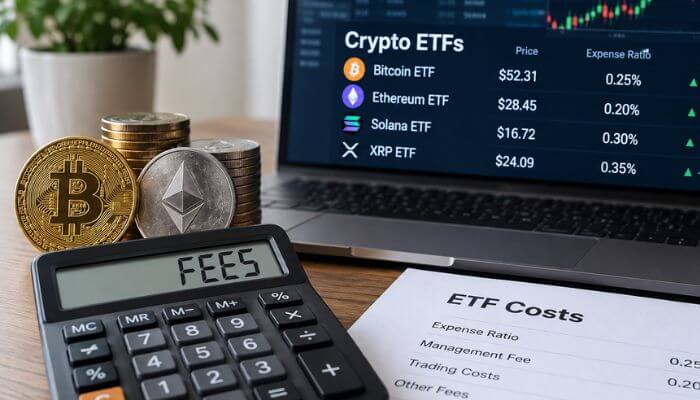
Expense ratios receive most of the attention, but they are not the only cost to consider when comparing fintechzoom.com crypto etf options.
Investors should consider:
- Sponsor or management fees
- Bid-ask spreads
- Premiums or discounts to NAV
- Broking commissions or trading fees, where applicable
- Staking-related fees
- Options-related costs
- Futures roll costs
- Tracking differences
Annual Fee Example
Assume a hypothetical $10,000 investment remains unchanged for one year.
| Annual Fee | Approximate Annual Cost |
|---|---|
| 0.15% | $15 |
| 0.19% | $19 |
| 0.25% | $25 |
| 0.50% | $50 |
| 0.75% | $75 |
| 0.95% | $95 |
These figures show only the approximate annual fund fee on a $10,000 investment.
They do not include investment gains or losses, taxes, bid-ask spreads, brokerage costs, or other expenses that may apply.
What Are NAV, Premium, and Discount?
NAV, or net asset value, represents the value of an ETP’s assets after liabilities. When researching fintechzoom.com crypto etf products, it is useful to compare NAV with the actual market price because the two can differ slightly during trading.
If an ETP trades above its NAV, it is trading at a premium. If it trades below NAV, it is trading at a discount. Large and actively traded products often have relatively small differences because high liquidity can help keep market prices close to the value of the underlying crypto holdings.
For example, BlackRock reported a 30-day median bid-ask spread of 0.02% for IBIT and a premium or discount of approximately -0.01% on September 8, 2026. Smaller or less actively traded crypto products may experience wider spreads and larger differences between market price and NAV.
Why Creation and Redemption Matter
Creation and redemption are important because they help keep an ETP’s share price close to the value of its underlying assets.
Authorized participants can create or redeem large blocks of shares when market conditions create meaningful differences between the ETP price and its underlying value. In July 2025, the SEC permitted in-kind creation and redemption mechanisms for crypto ETPs, allowing qualifying institutional participants to exchange cryptocurrency directly for creation or redemption baskets.
Retail investors normally do not use this process. They simply buy and sell ETP shares through their brokerage accounts.
Do Crypto ETFs Trade 24/7?
Crypto ETFs and ETPs generally do not trade 24 hours a day.
Cryptocurrencies such as Bitcoin can trade continuously, including at night and on weekends, while U.S.-listed crypto ETPs trade during available securities-market sessions.
This difference can create overnight and weekend risk. For example, Bitcoin could fall sharply on a Saturday while a U.S.-listed Bitcoin ETP is not trading. When the securities market reopens, the ETP’s price may adjust quickly to reflect the move that occurred while the exchange was closed.
Fidelity similarly notes that products such as FBTC and FETH trade during stock-market hours rather than continuously.
Crypto ETF Tax Considerations
Crypto ETF taxes can vary based on the product structure, account type, investor location, and current tax rules. When comparing fintechzoom.com crypto etf products, investors should check how each fund is treated for tax purposes.
Important tax factors include:
- Capital gains
- Capital losses
- Fund distributions
- Staking rewards
- Holding period
- Retirement-account treatment
- State and federal taxes
- Trust or partnership reporting
For example, Franklin states that the Franklin Crypto Index ETF, ticker EZPZ, issues a Schedule K-1.
Tax reporting can differ from one crypto ETP to another, so investors should review the fund’s latest tax documents before investing.
Tax laws can also change. Investors with specific questions should consult a qualified tax professional.
How to Compare Crypto ETFs Before Investing
Choosing a crypto ETF should involve more than checking the ticker or headline fee. Investors comparing fintechzoom.com crypto etf products should look at the asset, structure, costs, liquidity, and risks together.
Before investing, check:
- Underlying asset: Bitcoin, Ether, Solana, XRP, Dogecoin, or a basket of cryptocurrencies
- Product structure: Spot, futures-based, staking-enabled, leveraged, active, index-based, or options-based
- Expense ratio: Compare ongoing fees and check whether any waiver is temporary
- Trading liquidity: Review trading volume and bid-ask spreads
- Assets under management: Larger AUM can indicate greater adoption, but it does not guarantee better returns
- Custody: Check which institution safeguards the cryptocurrency
- Benchmark: Understand how the product measures performance and NAV
- Staking: Review rewards, validator arrangements, fees, unstaking periods, and slashing risk
- Leverage: Watch for terms such as ‘2x’, ‘inverse’, ‘daily’, or leveraged
- Prospectus: Confirm the investment objective, fees, risks, custody, derivatives, creation and redemption process, and tax structure
The best crypto ETF is not always the one with the lowest fee. A product with stronger liquidity, simpler structure, tighter spreads, and suitable risk characteristics may be a better fit for a particular investor.
How to Buy a Crypto ETF
Buying a crypto ETF or ETP is generally similar to buying a stock. Investors researching fintechzoom.com crypto etf products can usually purchase them through a brokerage account that supports the selected fund.
The basic process is simple:
- Choose a brokerage account that offers the crypto ETF or ETP you want.
- Search for the ticker and confirm the official fund name before placing an order.
- Review the issuer page and prospectus to check fees, risks, holdings, and investment strategy.
- Check the bid and ask prices to understand the current trading spread.
- Choose an order type. A market order prioritizes execution, while a limit order lets you set the highest price you are willing to pay or the lowest price you are willing to accept when selling.
- Monitor the investment after purchase for changes in fees, liquidity, custody arrangements, fund size, or strategy.
Investors should also confirm that the product matches their risk tolerance and investment goals before buying.
Which Type of Crypto ETF Fits Different Goals?
There is no single best crypto ETF for every investor. People comparing fintechzoom.com crypto etf products should match the product structure with their investment goal and risk tolerance.
| Investor Goal | Product Type to Research |
|---|---|
| Basic Bitcoin exposure | Spot Bitcoin ETP |
| Basic Ether exposure | Spot Ether ETP |
| Ether exposure with staking | Staking Ethereum ETP |
| Solana exposure plus staking | Solana staking ETP |
| XRP exposure | XRP ETP |
| Litecoin exposure | Litecoin ETP |
| Dogecoin exposure | Dogecoin ETP |
| Exposure to several cryptocurrencies | Crypto index product |
| Professional asset selection | Active crypto ETP |
| Bitcoin exposure plus income | Options-based Bitcoin ETF |
| Amplified short-term exposure | Leveraged crypto ETF |
This table is intended as an educational framework, not an investment recommendation. Investors should still compare fees, liquidity, risks, custody, and the latest prospectus before choosing a product.
Advantages of Crypto ETFs
Crypto ETFs can make digital-asset exposure easier to access and manage. Investors researching fintechzoom.com crypto etf products may find several practical advantages compared with buying cryptocurrency directly.
Key advantages include:
- Easy brokerage access: Crypto exposure can be purchased through a traditional brokerage account.
- No private-key management: Investors do not need to manage seed phrases, hardware wallets, or wallet addresses.
- Portfolio integration: Crypto products can sit alongside stocks, bonds, and other investments in the same account.
- Institutional custody: The fund uses designated custody arrangements instead of requiring personal self-custody.
- Potential retirement-account access: Some crypto ETPs may be available in eligible retirement or tax-advantaged accounts, depending on broker and plan rules.
Risks of Crypto ETFs
Crypto ETFs can simplify access, but they do not remove the risks associated with digital assets.
Important risks include:
- Price volatility: Bitcoin, Ether, Solana, and other cryptocurrencies can experience sharp gains and severe declines.
- Concentration risk: A single-asset crypto ETP may depend almost entirely on the performance of one volatile cryptocurrency.
- Tracking risk: Fees, spreads, and fund mechanics can cause performance to differ from the underlying crypto asset.
- Custody risk: Professional custody reduces personal key-management responsibility but does not eliminate operational or custody-related risk.
- Liquidity risk: Smaller altcoin products may have lower trading volume and wider bid-ask spreads.
- Staking risk: Staking can introduce validator failure, slashing, network outages, and withdrawal delays.
- Leverage risk: Leveraged crypto ETFs can magnify losses, and daily resetting can produce unexpected long-term results.
- Regulatory risk: Rules affecting crypto products, custody, staking, exchanges, and issuers can continue to change.
Fidelity specifically warns that staking in FSOL can involve risks such as slashing and delays before staked assets become available for withdrawal.
Crypto ETF Red Flags
Not every crypto ETF deserves equal consideration. When reviewing fintechzoom.com crypto etf products, investors should look beyond the headline return or advertised yield and examine how the fund actually works.
Warning signs can include:
- Poor trading quality: Very low volume, wide bid-ask spreads, or large premiums and discounts to NAV
- High or unclear costs: Expensive fees, short-term fee waivers, or charges that are difficult to identify
- Complex strategies: Heavy leverage, daily-reset objectives, or complicated derivatives
- Custody concerns: Unclear information about how the underlying crypto assets are stored and protected
- Staking complexity: Difficult-to-understand validator arrangements, reward policies, fees, or unstaking terms
- Aggressive marketing: High yields or return potential emphasized without equal attention to risk
- Unclear investment objectives: A product structure that is difficult to explain or understand
Investors should be able to understand what the fund owns, how it makes money, what it costs, and what could cause losses before investing.
Does ETF Approval Mean a Cryptocurrency Is Safe?
No. Approval of an exchange-traded product does not mean the underlying cryptocurrency has been declared safe or low risk. This is an important point for readers comparing fintechzoom.com crypto etf products.
When the SEC approved spot Bitcoin ETP listings, the decision concerned the listing and trading of those investment products. It was not an endorsement of Bitcoin itself or a guarantee that investors would avoid losses.
ETF approval does not guarantee future price growth, permanent liquidity, network security, regulatory certainty, or long-term adoption.
Investors should therefore evaluate two separate things: the cryptocurrency itself and the structure of the fund that provides exposure to it.
Crypto Regulation in 2026
Crypto regulation in the U.S. is still developing, so investors researching fintechzoom.com crypto etf products should pay attention to whether a rule is final, proposed, or still under review.
In September 2025, the SEC approved generic listing standards for qualifying commodity-based ETPs. This made it easier for eligible digital-asset products to reach the market without requiring a separate exchange rule change for every new product.
In August 2026, the SEC proposed Regulation Crypto Assets, which could create a new framework for certain crypto-related securities offerings.
As of September 2026, this proposal is not final. The SEC listed October 20, 2026 as the public-comment deadline.
When reading crypto ETF news, always check whether the update is:
- A final rule
- An approved exchange rule
- A proposed regulation
- An effective fund registration
- An issuer announcement
These categories are different, and a proposal should not be treated as an approved rule.
Why the Crypto ETF Market Is Different in 2026
The crypto ETF market has changed significantly since the first U.S. spot Bitcoin ETPs began trading in 2024. Investors researching fintechzoom.com crypto etf products in 2026 now have far more choices than simple Bitcoin exposure.
The market now includes staking products, multi-asset index funds, actively managed crypto ETPs, leveraged strategies, altcoin products, and options-based Bitcoin income funds.
Competition is also increasing around fees, liquidity, staking rewards, and product design.
The next phase of the market will likely depend on several factors, including:
- Adoption of staking-enabled products
- Growth of active multi-token ETPs
- Demand for single-asset versus index products
- Liquidity in smaller altcoin funds
- Interest in Bitcoin income strategies
- Continued fee competition among issuers
Crypto ETFs are no longer one simple investment category. By 2026, they have developed into a broader range of strategies with different goals, costs, and risks.
FintechZoom.com Crypto ETF Research vs Official Sources
FintechZoom and other crypto publications can help investors discover news and market developments.
However, readers researching FintechZoom.com Crypto ETF should verify investment details using primary sources.
A strong research hierarchy is:
- SEC filings
- Official fund issuer websites
- Exchange information
- Independent financial research
- Crypto news and commentary websites
This approach matters because fund fees, AUM, staking policies, product structures, and regulations can change rapidly.
What Should Crypto ETF Investors Watch Next?
The crypto ETF market is still developing, so investors following fintechzoom.com crypto etf products should watch more than price performance alone.
Key areas to monitor include:
- Fund flows: Inflows and outflows can show whether demand for a particular crypto product is strengthening or weakening.
- Trading activity: Higher volume and tighter bid-ask spreads can indicate improving liquidity.
- Staking: Ethereum and Solana products may compete more aggressively through staking features and reward structures.
- Active management: Products such as TKNZ show that professionally managed multi-token strategies are becoming part of the market.
- Crypto indexes: Multi-asset products may attract investors who prefer broader crypto exposure instead of choosing one token.
- Income strategies: Options-based Bitcoin funds are creating a separate category focused partly on generating distributions.
- Regulation: Future SEC decisions, rule changes, and federal legislation could affect product availability, custody, staking, and market structure.
The most important developments will likely come from a combination of regulation, product innovation, liquidity, and investor demand.
Is a Crypto ETF Better Than Buying Crypto Directly?
Neither structure is automatically better.
A crypto ETP may appeal to someone who wants brokerage simplicity, institutional custody, traditional tax reporting, or potential retirement-account access.
Direct cryptocurrency may appeal to someone who wants self-custody, blockchain transfers, direct staking, decentralized applications, or broader trading hours.
Some investors may use both approaches for different purposes.
The important point is understanding that buying shares of an ETP is not the same as owning transferable cryptocurrency in a personal wallet.
Conclusion
The fintechzoom.com crypto etf market in 2026 now includes Bitcoin, Ethereum, Solana, XRP, staking products, crypto indexes, active funds, leveraged ETFs, and income strategies.
Investors should use financial coverage as a starting point and verify fees, liquidity, custody, staking rules, and regulatory details through official fund issuers and SEC filings.
Anyone researching fintechzoom.com crypto etf products should compare both the cryptocurrency and the fund structure before investing.
Crypto ETFs can make digital assets easier to access, but they do not remove volatility or investment risk.
fintechzoom.com crypto etf
FAQs About FintechZoom.com Crypto ETF
1. Can FintechZoom.com Crypto ETF products pay dividends?
Most spot crypto ETFs do not pay traditional company dividends. However, some income-focused or staking products may generate distributions depending on their strategy.
2. Is there a minimum investment for FintechZoom.com Crypto ETF products?
Usually, investors only need enough money to purchase one share or a fractional share if their brokerage supports fractional ETF investing.
3. Are FintechZoom.com Crypto ETF investments FDIC insured?
No. Crypto ETFs are investment products, not bank deposits. They are not protected by FDIC insurance and can lose value.
4. Can a crypto ETF close or be liquidated?
Yes. An issuer may close an ETF because of low assets, limited demand, restructuring, or other business reasons. Investors typically receive proceeds after liquidation.
5. Can FintechZoom.com Crypto ETF shares be short sold?
Some crypto ETF shares may be eligible for short selling through certain brokerage accounts, subject to broker rules, share availability, and margin requirements.
6. Do crypto index ETFs rebalance their holdings?
Many crypto index products periodically rebalance according to their index methodology. The timing and weighting rules vary by product.
7. Can crypto ETFs use derivatives?
Yes. Futures, options, swaps, or other derivatives may be used by certain leveraged, income, or futures-based crypto ETFs. Investors should check the prospectus.
8. What happens if a cryptocurrency forks while an ETF holds it?
Treatment depends on the fund’s governing documents. An issuer may retain, sell, distribute, or disregard assets created by a blockchain fork depending on its policy.
Disclaimer: This article is for educational purposes only. It is not financial, investment, legal, or tax advice. Cryptocurrency and crypto-related investment products can experience substantial losses.iShares Bitcoin Trust ETF
