
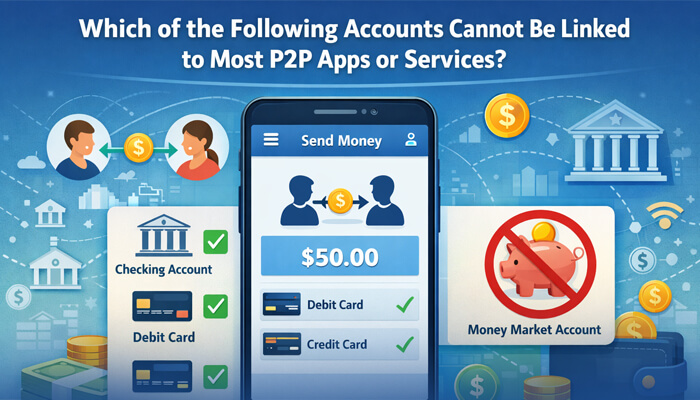

Digital payment technology has transformed the way people send and receive money. Today, peer to peer payment apps allow individuals to transfer funds instantly using smartphones or computers. From paying a friend for dinner to splitting rent with roommates, p2p payments have become an essential part of modern financial transactions.
However, many users ask an important question: which of the following accounts cannot be linked to most p2p apps or services? Understanding this concept helps users choose the correct funding source and avoid payment issues. In most cases, money market accounts cannot be linked to most P2P apps or services, while checking accounts, debit cards, and sometimes credit cards can be connected easily.
This article provides a deep research guide explaining how person to person payments work, which accounts can or cannot be linked, and how to safely use modern p2p payment platforms like digital wallets and banking apps.
What Is P2P Payment?
Before exploring which accounts cannot be linked, it is important to understand what is p2p payment.
Peer-to-peer (P2P) payment refers to a digital transaction that allows one individual to send money directly to another individual through a mobile app or online platform. These systems eliminate the need for traditional intermediaries like checks or cash.
Most peer to peer payment apps operate by linking a user’s bank account, debit card, or digital wallet to the application. Once connected, users can send or receive money instantly using an email address, phone number, username, or payment ID.
These modern systems are part of the broader ecosystem of digital payment apps, mobile payment services, and online money transfer platforms that allow people to send money online instantly.
Examples of popular p2p payments systems include mobile payment apps, banking transfer services, and digital wallets integrated with smartphones.
Popular Peer to Peer Payment Apps
Peer to peer payment apps have become widely adopted across the world. Some of the most popular peer to peer payment apps include:
- PayPal
- Venmo
- Cash App
- Zelle
- Apple Pay
- Google Pay
These instant money transfer apps allow users to send person to person payments instantly using linked bank accounts, debit cards, or digital wallet payments.
Many of these platforms also support features such as payment requests, transaction history, and integration with banking systems. Their ease of use has made them one of the most widely used mobile payment services globally.
Popular P2P Payment Apps and Their Features
| P2P Payment App | Key Features | Supported Payment Sources | Typical Use Case |
| PayPal | Global payments, buyer protection | Bank account, debit card, credit card | Online purchases and international transfers |
| Venmo | Social payment feed | Bank account, debit card, credit card | Splitting bills with friends |
| Cash App | Mobile wallet and investing features | Bank account, debit card | Sending quick personal payments |
| Zelle | Direct bank-to-bank transfers | Bank account | Fast transfers between bank users |
| Apple Pay | Integrated with Apple devices | Debit card, credit card | Contactless payments and P2P transfers |
| Google Pay | Android digital wallet | Bank account, debit card | Mobile payments and transfers |
How Peer-to-Peer Payment Apps Work
Most peer-to-peer payment apps follow a simple process:
1. Account Registration
Users create an account using their email address, phone number, or login credentials.
2. Linking a Payment Source
The user links a financial account, such as:
- Checking account
- Debit card
- Credit card (sometimes with fees)
3 Sending Money
The sender enters the recipient’s contact information and payment amount.
4. Processing the Transaction
The p2p payment platform transfers funds through banking networks or digital wallet balances.
5. Receiving Funds
The recipient can either:
- Keep the funds in the app wallet
- Transfer them to their bank account.
These steps make person to person payments fast, convenient, and accessible.
How P2P Payments Are Processed
Most peer to peer payment apps process transactions using banking networks such as ACH transfers, debit card networks, or internal wallet balances.
Some platforms offer instant transfers using card networks, while others process payments through bank-to-bank transfers that may take a few hours or one business day to complete.
These technologies allow P2P apps to move funds quickly while maintaining secure person to person payments and reliable digital transaction processing.
Which of the Following Accounts Cannot Be Linked to Most P2P Apps or Services?
The correct answer is:
Money Market Account
Money market accounts generally cannot be linked to most p2p apps or services because they are designed primarily for savings and investment purposes rather than frequent transactional payments.
Unlike checking accounts, money market accounts often have:
- Transaction limits
- Withdrawal restrictions
- Regulatory limitations
- Limited payment network compatibility
Because p2p payments require fast transfers and frequent transactions, most platforms only support accounts designed for daily banking activity.
Accounts That Can Be Linked to Most P2P Payment Apps
Most p2p payment platforms allow users to connect the following accounts:
Checking Accounts
Checking accounts are the most common payment source because they support frequent transfers and direct bank integration.
Debit Cards
Debit cards linked to bank accounts allow instant transfers and quick payments.
Credit Cards
Some peer to peer payment apps allow credit cards, although they often charge processing fees.
These account types are designed for regular financial transactions, making them compatible with person to person payments.
Supported vs Unsupported Accounts in P2P Payment Apps
Understanding which accounts work with p2p payments can help users avoid payment errors.
| Account Type | Can It Be Linked to P2P Apps? | Explanation |
| Checking Account | Yes | Designed for frequent transactions |
| Debit Card | Yes | Allows instant transfers |
| Credit Card | Sometimes | May include processing fees |
| Savings Account | Sometimes | Limited compatibility |
| Money Market Account | Usually No | Transaction restrictions |
This table highlights why money market accounts cannot be linked to most p2p apps or services.
Why Money Market Accounts Usually Cannot Be Linked
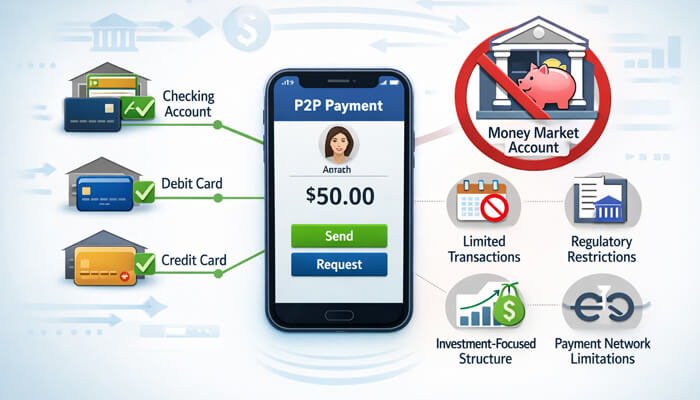
Money market accounts operate differently from transactional accounts. They are designed to earn interest and function similarly to savings accounts.
Reasons they are usually incompatible with p2p payment apps include:
1. Limited Transactions
Money market accounts typically restrict the number of monthly withdrawals.
2. Regulatory Restrictions
Bank regulations sometimes limit electronic transfers from these accounts.
3. Investment-Focused Structure
These accounts are intended for saving or investment, not daily spending.
4. Payment Network Limitations
Most p2p payment platforms rely on ACH or card networks that are optimized for checking accounts.
Because of these limitations, money market accounts cannot be linked to most p2p apps or services.
Transaction Limits in P2P Payment Apps
Most peer to peer payment apps impose daily or weekly transaction limits to reduce fraud and ensure regulatory compliance.
For example, new users may have lower limits until their accounts are fully verified.
Transaction limits usually depend on:
- identity verification
- account type
- payment source
- platform policies
These limits help protect users and maintain the security of online money transfer platforms.
Fees Associated With P2P Payments
Although many p2p payments are free, certain transactions may include fees depending on the payment method used.
Common fees include:
Instant Transfer Fees
Some platforms charge a small fee for transferring funds instantly to a bank account.
Credit Card Processing Fees
Using a credit card to send person to person payments may involve a processing fee.
International Transfer Fees
Cross-border payments may include additional service fees.
Understanding these charges helps users choose the best peer to peer payment app for their needs.
Benefits of Using P2P Payment Apps
The rapid growth of p2p payments is driven by their convenience and efficiency.
Instant Transfers
Most person to person payments are processed instantly or within minutes.
Easy User Experience
Users only need a smartphone and internet connection.
No Need for Cash
Digital payments eliminate the need for physical money.
Global Growth of Digital Payments
Systems such as digital wallet payments and mobile banking apps continue to expand worldwide.
In countries like India, systems such as digital bank transfers enable peer to peer payment apps to move money between accounts instantly.
Advantages and Disadvantages of P2P Payments
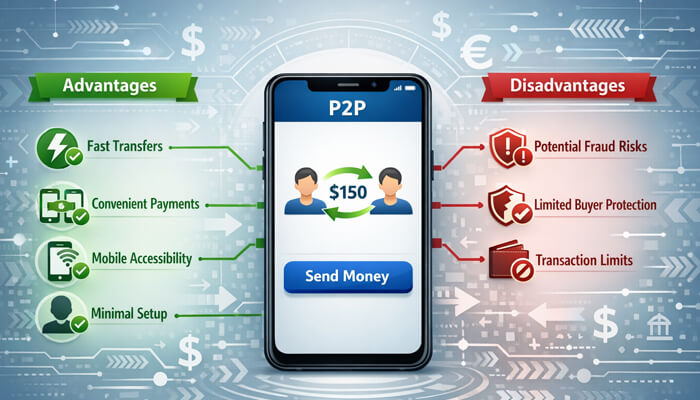
Like any financial technology, p2p payments have both advantages and limitations.
Advantages
- Fast transfers
- Convenient payments
- Mobile accessibility
- Minimal setup
Disadvantages
- Potential fraud risks
- Limited buyer protection
- Transaction limits
Understanding these pros and cons helps users make informed decisions when using digital payment apps.
Security Considerations in P2P Payments
Although p2p payments are convenient, users should also consider security risks.
Common Risks
- Fraudulent payment requests
- Sending money to the wrong person
- Scam transactions
Many peer to peer payment apps use security features such as:
- Encryption
- Fraud detection
- Multi-factor authentication
These security tools help protect users when making person-to-person payments.
Fake CashApp and P2P Payment Scams
As p2p payment platforms grow in popularity, scams such as fake Cash App accounts have also increased.
Scammers may:
- Pretend to be customer support
- Send fake payment confirmations
- Create duplicate payment accounts
- Request urgent payments from victims
Users should always verify payment requests before sending money through person-to-person payment apps.
How to Link a Bank Account to a P2P Payment App
Connecting a bank account to a peer-to-peer payment app is usually simple.
Follow these steps:
- Download the peer to peer payment app
- Create a user account
- Navigate to payment methods
- Enter bank account or debit card details
- Verify the account
- Start sending person to person payments
This process allows users to quickly start using instant money transfer apps.
Common Issues When Linking Accounts to P2P Payment Apps
Sometimes users cannot link their accounts to P2P apps due to technical or policy limitations. Common issues include:
- Incorrect bank account details
- Unsupported account types, such as money market accounts
- Security verification failures
- Bank restrictions on third-party payment platforms
If a linking issue occurs, users should check their account type and confirm that the P2P payment platform supports that financial account type.
The Future of P2P Payments
The future of peer to peer payment apps is expected to expand with innovations such as:
- AI-driven fraud detection
- Blockchain-based payment systems
- Integrated digital banking
- Global instant payment networks
As financial technology evolves, p2p payments will become even faster, safer, and more accessible worldwide.
P2P Payments FAQS
1. Which of the following accounts cannot be linked to most P2P apps or services?
Money market accounts usually cannot be linked to most P2P apps or services. These accounts have transaction limits and are designed for savings rather than frequent digital payments.
2. What is a P2P payment?
A P2P payment is a digital transfer that allows one person to send money directly to another using a mobile app or online payment platform.
3. Which accounts can be linked to most peer-to-peer payment apps?
Most P2P apps support checking accounts, debit cards, and sometimes credit cards. These accounts allow fast transactions and instant money transfers.
4. Are P2P payment apps safe to use?
P2P payment apps are generally safe when used correctly. Users should verify recipients and enable security features like two-factor authentication.
5. Why do P2P apps prefer checking accounts?
Checking accounts are designed for regular transactions and fast transfers. This makes them more compatible with peer-to-peer payment platforms.
Conclusion
Understanding which of the following accounts cannot be linked to most p2p apps or services is important for anyone using digital payment platforms. The correct answer is money market accounts, which typically cannot be linked due to transaction restrictions and their savings-focused structure.
In contrast, checking accounts, debit cards, and sometimes credit cards are widely supported by peer-to-peer payment apps. By using the correct account type and following security best practices, users can safely take advantage of the convenience offered by person-to-person payments.
As digital finance continues to evolve, p2p payment platforms will remain a central part of everyday financial transactions.
Disclaimer: The information in this article is for educational and informational purposes only. Payment platform features and policies may change, so readers should verify details with official P2P app providers before making financial decisions.
