

PolyPlay cryptocurrency is a gaming-focused crypto project built around e-sports tournaments, NFT rewards, staking, and a broader blockchain gaming ecosystem on the WAX network. Unlike many generic tokens, PolyPlay aimed to create a platform where gamers could participate, earn rewards, and engage with digital assets in a competitive environment.
However, for users researching PolyPlay cryptocurrency today, the story is more complex than a typical GameFi project. Public information suggests that the project experienced a security issue and later transitioned toward MetaPlay (MPLAY), which significantly changed its structure and raised questions about its current status and continuity.
Because of this, understanding PolyPlay cryptocurrency requires more than just looking at its original concept. Users should focus on its project history, migration details, and current activity signals to get a clearer picture of whether it remains relevant or functions mainly as a legacy gaming token.
| Detail | Information |
|---|---|
| Token Name | PolyPlay |
| Ticker Symbol | PLAY |
| Category | GameFi / NFT Gaming |
| Blockchain | WAX |
| Primary Use Case | E-sports tournaments, NFT rewards, and staking |
| Current Status | Legacy / Migrated to MetaPlay (MPLAY) |
What Is PolyPlay Cryptocurrency?
PolyPlay cryptocurrency was presented as a blockchain gaming token designed to support amateur e-sports and NFT-based competitions. The project’s public narrative focused on tournament rewards, staking, a launchpad, and other gaming-related platform features. It was positioned as part of the WAX ecosystem rather than as a general-purpose payment coin or a large smart-contract platform.
This distinction matters. PolyPlay cryptocurrency was marketed as a niche token with utility tied to gaming participation and ecosystem activity. That gave it a clearer product story than many low-cap tokens that launched with little real use-case explanation.
How Was PolyPlay Supposed to Work?
According to the original project descriptions, PolyPlay planned a larger ecosystem rather than a token-only model. The vision included NFT tournaments, staking, a launchpad, sponsorship promotion, livestream exposure, and the PLAYROOM Store. Its roadmap reflected a typical 2021 GameFi strategy focused on community growth, NFTs, rewards, partnerships, and gaming engagement.
The broader idea behind PolyPlay cryptocurrency was that token value would come from user participation. Instead of relying only on speculation, the token narrative depended on attracting gamers, NFT users, partners, and tournament activity. That was a strong concept on paper, even if long-term execution appears less clear today.
PolyPlay Cryptocurrency and the WAX Blockchain
One important technical detail about PolyPlay cryptocurrency is its connection to the WAX blockchain. WAX has long been associated with blockchain gaming and NFTs, which made it a logical choice for a tournament-focused gaming token. The infrastructure aligned with the project’s stated goals of supporting digital collectibles, enabling faster interactions, and making onboarding easier for users.
This does not prove the project succeeded, but it does show the original concept matched the blockchain environment it chose. In other words, PolyPlay cryptocurrency was built around a theme that made technical sense for its time.
What Happened to PolyPlay Cryptocurrency?
This is the most important question for anyone researching PolyPlay cryptocurrency today.
Public references cited in your draft indicate that PolyPlay was later reported as hacked and migrated to MetaPlay (MPLAY). That changes the token’s entire risk profile. Instead of evaluating it as a normal, uninterrupted project, readers need to see it as a token with a disrupted history, possible contract complexity, and fragmented continuity.
A hack and migration can make token research much harder. Investors may need to verify which contract is relevant, whether liquidity is still active, whether exchange support remains current, and whether official channels are still maintained. This is one reason PolyPlay cryptocurrency should be approached with much more caution than a typical active gaming token.
Why PolyPlay Cryptocurrency Struggled
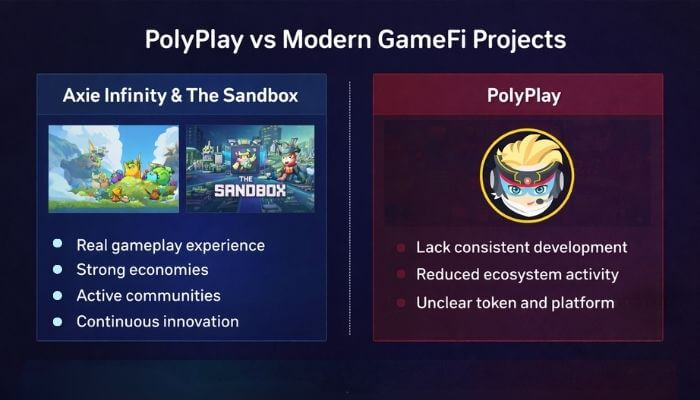
To fully understand PolyPlay cryptocurrency, it’s important to look beyond its original vision and examine why the project lost momentum over time. While the concept was strong during the early GameFi phase, several key factors appear to have limited its long-term growth.
1. Impact of the Reported Hack
One of the biggest turning points for PolyPlay cryptocurrency was the reported security issue and migration to MetaPlay (MPLAY).
Security incidents in crypto often lead to:
- loss of user trust
- confusion around token contracts
- reduced participation
Even if recovery efforts are made, rebuilding credibility can be extremely difficult.
2. Rising Competition in GameFi
PolyPlay launched during a period when many gaming tokens were entering the market.
Over time, newer GameFi projects have been introduced:
- better gameplay integration
- stronger token utility
- more active communities
As competition increased, older projects like PolyPlay cryptocurrency faced challenges in maintaining relevance.
3. Loss of Momentum and Adoption
Early-stage crypto projects rely heavily on continuous growth.
For PolyPlay cryptocurrency, signs of slowing momentum may include:
- reduced platform activity
- fewer updates or announcements
- declining community engagement
Without consistent development and user growth, even well-designed ecosystems can fade.
4. Unclear Communication and Updates
Clear communication is critical in crypto projects, especially after major events like migrations or security issues.
If users struggle to find:
- official updates
- clear migration instructions
- verified project status
It creates uncertainty, which can discourage both users and investors.
Key Insight
The story of PolyPlay cryptocurrency highlights a common pattern in the crypto space:
A strong concept is not enough without security, transparency, and continuous execution
For modern investors and researchers, this makes PolyPlay less of a growth case and more of a learning example from the early GameFi era.
Is PolyPlay Cryptocurrency Still Active?
Public information in your article suggests that PolyPlay is better documented as a legacy or historical GameFi project than as a strongly active current ecosystem. Token pages and market references still exist, but the information appears inconsistent across platforms, with some sources showing limited or incomplete market data.
That inconsistency is itself a warning sign. In plain terms, PolyPlay cryptocurrency appears easier to verify as an old concept than as a clearly active modern project. That does not automatically mean it is worthless, but it does mean researchers should verify current contracts, migration details, liquidity, exchange support, and active communication channels before making any decision.
Where to Check PolyPlay Cryptocurrency Now
If you are researching PolyPlay cryptocurrency, it’s important to verify real-time data before making any assumptions. Since the project has a complex history, users should rely on multiple trusted sources and validation steps.
1. Check Market Data Platforms
Start by searching for PolyPlay cryptocurrency on platforms like CoinMarketCap and CoinGecko.
These platforms can help you:
- See if the token is still listed
- Check price history and trading volume
- Identify supported exchanges
- Confirm whether the token is marked as inactive or migrated
2. Verify the Official Token Contract
Always verify the correct contract address before interacting with any token.
Because PolyPlay cryptocurrency reportedly underwent a migration, there may be:
- old contracts (PLAY)
- new contracts (MPLAY)
Only trust contract details from:
- official project announcements
- verified blockchain explorers
- trusted crypto data platforms
3. Confirm Migration to MetaPlay (MPLAY)
One of the most critical steps is confirming whether the PolyPlay ecosystem has fully transitioned to MetaPlay (MPLAY).
Check:
- official announcements or archives
- token swap details (if available)
- whether PLAY is still supported or deprecated
This step is essential because buying an outdated token version can carry significant risk.
4. Check Liquidity and Exchange Support
Even if PolyPlay cryptocurrency appears listed, you must confirm:
- active trading pairs
- real liquidity (not just listed tokens)
- supported exchanges
Low liquidity or inactive trading can make it difficult to:
- buy or sell tokens
- exit positions
- determine accurate pricing
5. Evaluate Current Activity Signals
Look for signs that the project is still active:
- recent updates or announcements
- active social media or community channels
- development progress or partnerships
If these signals are missing or outdated, it may indicate that PolyPlay cryptocurrency is no longer actively maintained.
Key Takeaway
Before taking any action, treat PolyPlay cryptocurrency as a high-verification project. Always confirm contract details, migration status, and liquidity across multiple sources rather than relying on a single listing.
Is PolyPlay Cryptocurrency a Good Investment?
For most readers, PolyPlay cryptocurrency looks more like a high-risk legacy token than a straightforward investment opportunity.
The original concept had some strengths. It focused on gaming and e-sports, tied the token to NFTs and tournaments, and aimed to build a broader ecosystem rather than launching as a meaningless standalone coin. Those are legitimate strengths from a product-narrative perspective.
However, the risks are significant. The project history includes a reported hack and migration, and current public activity appears less robust than the original platform vision. That means anyone thinking about buying should judge the token on current verifiable evidence, not on old whitepaper language or marketing ideas from the GameFi boom period.
Investors should always verify real-time data, contract details, and current project activity before making any financial decisions related to PolyPlay cryptocurrency.”
Risks You Should Understand Before Buying
| Risk Factor | Explanation |
|---|---|
| Hack History | The reported security issue affected trust and continuity |
| Migration Complexity | Transition to MPLAY creates confusion around tokens |
| Low Activity Signals | Limited updates and ecosystem engagement |
| Liquidity Risk | Possible low trading volume and exchange support |
| Data Inconsistency | Information varies across platforms |
PolyPlay vs Modern GameFi Projects
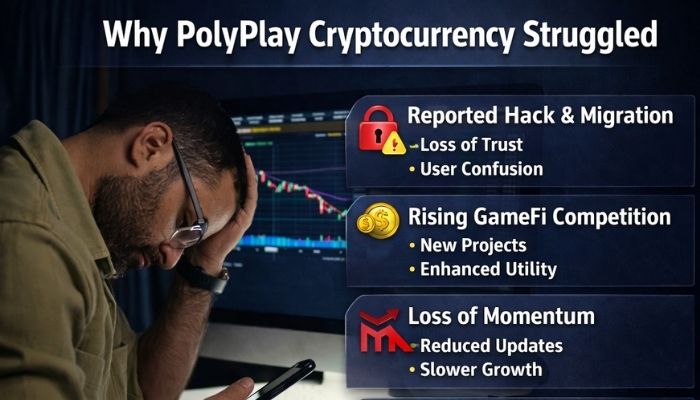
To better understand the current position of PolyPlay cryptocurrency, it helps to compare it with newer and more active GameFi ecosystems.
While PolyPlay was built around gaming tournaments, NFTs, and staking, modern GameFi projects have evolved significantly in terms of usability, community, and execution.
Example 1: Axie Infinity
Axie Infinity is one of the most recognized blockchain gaming ecosystems, known for its play-to-earn model and active user
base.
Key Differences vs PolyPlay:
- Active gameplay ecosystem vs limited visible activity
- Strong NFT economy vs unclear current usage
- Ongoing development vs fragmented updates
- Large global community vs reduced engagement signals
While PolyPlay cryptocurrency focused on tournament-based rewards, Axie Infinity built a fully playable gaming economy, which helped sustain long-term growth.
Example 2: The Sandbox
The Sandbox represents a newer generation of GameFi platforms focused on virtual worlds, user-generated content, and digital land ownership.
Key Differences vs PolyPlay:
- Interactive metaverse vs concept-driven ecosystem
- Active partnerships (brands, creators) vs unclear current expansion
- Continuous updates vs limited recent visibility
- Strong token utility (SAND) vs uncertain token continuity
Compared to PolyPlay cryptocurrency, The Sandbox shows how GameFi has evolved toward immersive digital experiences and creator economies.
Clear Comparison: PolyPlay vs Modern GameFi
| Feature | PolyPlay Cryptocurrency | Modern GameFi Projects |
|---|---|---|
| Ecosystem Status | Legacy / unclear activity | Active and expanding |
| User Base | Limited or uncertain | Large and growing |
| Utility | Tournaments, NFTs (concept-based) | Gameplay, metaverse, DeFi integration |
| Development | Fragmented after migration | Continuous updates |
| Trust & Transparency | Affected by hack and migration | Strong communication and visibility |
Key Insight
The comparison highlights a major shift in the GameFi space:
- Early projects like PolyPlay cryptocurrency focused on ideas and token utility concepts
- Modern GameFi platforms focus on real user experience, active ecosystems, and continuous development
- This is why newer projects tend to maintain stronger momentum, while older or disrupted tokens become harder to evaluate.
PolyPlay vs Newer Gaming Tokens
Compared with newer gaming tokens, PolyPlay cryptocurrency appears more like a legacy GameFi case study than a clearly expanding ecosystem.
Newer gaming tokens are often judged on:
- current user activity
- active social/community channels
- exchange liquidity
- updated tokenomics
- visible development progress
- transparent partnerships
PolyPlay’s challenge is that its public story is heavily tied to its older vision and later disruption. That makes it harder to evaluate next to newer projects that offer cleaner launch histories and easier contract verification. Based on your article, PolyPlay cryptocurrency is more useful for comparing GameFi evolution than for representing the strongest example of a current gaming token.
Lessons From PolyPlay for GameFi Investors in 2026
PolyPlay cryptocurrency offers a useful lesson for modern GameFi investors: a good idea is not enough.
The original concept made sense. Gaming, NFTs, staking, and tournament rewards were all attractive themes, especially during the early GameFi expansion. But long-term value in crypto depends on more than the concept. It depends on security, continuity, liquidity, community trust, and sustained execution.
For investors in 2026, the biggest takeaway is simple: always separate token narrative from current operational reality. A project can sound compelling in a whitepaper and still become difficult to trust if its market history becomes fragmented. In that sense, PolyPlay cryptocurrency is not just a token topic. It is also a reminder of how quickly GameFi sentiment can change when security and continuity break down. That inference is supported by the gap in your draft between PolyPlay’s original ecosystem vision and the later caution around hacked/migrated status.
Who Might Still Research PolyPlay Cryptocurrency?
PolyPlay cryptocurrency may still attract three main groups of readers:
- Crypto historians studying older GameFi projects
- Speculative traders tracking low-cap or migrated tokens
- Gaming-token researchers are comparing earlier e-sports crypto ideas with newer blockchain ecosystems
For most regular readers, though, this topic is more valuable as an educational case study than as a beginner-friendly investment pick. That conclusion fits the overall tone and evidence in your article.
Final Verdict on PolyPlay Cryptocurrency
PolyPlay cryptocurrency began as a gaming and e-sports token project centered on NFT tournaments, staking, and a gamer-focused ecosystem on WAX. The concept matched the GameFi trends of its time and was easier to understand than many low-utility tokens. But the project’s public record also includes a reported hack, migration to MPLAY, and fragmented current information.
Because of that, PolyPlay cryptocurrency is best approached as a high-risk legacy gaming token topic rather than a simple mainstream investment choice. Anyone researching it should verify the latest contract, migration history, liquidity, and official communication channels before taking action. From an SEO perspective, it remains a strong educational keyword because it combines gaming, NFTs, token utility, and crypto risk in one topic.
As with any crypto asset, decisions around PolyPlay cryptocurrency should be based on verified, up-to-date information rather than past project narratives or assumptions.
PolyPlay cryptocurrency (FAQs)
1. What is PolyPlay cryptocurrency, and how does it work?
A. PolyPlay cryptocurrency is a gaming-focused token built on the WAX blockchain, designed to support e-sports tournaments, NFT rewards, and staking within a blockchain gaming ecosystem. The project aimed to create value through user participation rather than simple token speculation.
2. Is PolyPlay cryptocurrency still active in 2026?
A. PolyPlay cryptocurrency is generally considered a legacy GameFi project, with limited signs of active development. While some token listings may still exist, current data appears inconsistent, so users should verify real-time activity, liquidity, and official updates before relying on it.
3. Was PolyPlay cryptocurrency affected by a hack?
A. Yes, public references suggest that PolyPlay cryptocurrency experienced a security issue and was later associated with a migration to MetaPlay (MPLAY). This event significantly impacted user trust and made the project more complex to evaluate.
4. Is PolyPlay cryptocurrency a good investment?
A. PolyPlay cryptocurrency is considered a high-risk investment due to its unclear current status, reported migration, and reduced ecosystem activity. Investors should carefully verify contract details, liquidity, and project updates before making any financial decisions.
5. Where can I check PolyPlay cryptocurrency data safely?
A. You can check PolyPlay cryptocurrency on trusted platforms like CoinMarketCap and CoinGecko, along with blockchain explorers. It’s important to verify the correct token contract, confirm migration details (PLAY vs MPLAY), and ensure there is real trading activity before interacting with the token.
Disclaimer: This article on PolyPlay cryptocurrency is for informational purposes only. Readers should verify current data, contract details, and project status independently before making any decisions.
